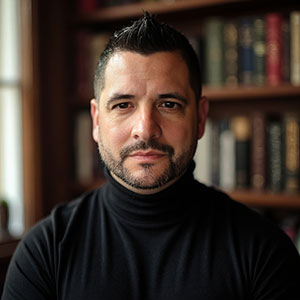
The work of peace: Dr. Margarita Tadevosyan on conflict, memory, and the long horizon of justice
The work of peace: Dr. Margarita Tadevosyan on conflict, memory, and the long horizon of justice
by George Cassidy Payne
1339 words
For Margarita Tadevosyan, peacebuilding is not an abstraction. It begins with memory.
She remembers standing in line for bread as a child in Armenia in the early 1990s, during the collapse of the Soviet Union and the war with Azerbaijan. Winters were bitterly cold. Electricity was scarce. Families cut wood in nearby parks just to heat their homes. Each person received only a small ration of bread. The uncertainty of those years etched itself into her childhood in ways she would only later understand.
“I remember being afraid until my father came home,” she recalls. Military police would take able-bodied men to the front lines. Her father, a physician with a PhD in medicine, was exempt from military service — but the fear remained until he walked through the door each evening.
It was a time of scarcity, but also of solidarity.
“Community was very strong,” she says.
Today, Tadevosyan serves as Executive Director of the Center for Peacemaking Practice at the Jimmy and Rosalynn Carter School for Peace and Conflict Resolution at George Mason University. Her career spans diplomacy, citizen dialogue initiatives, and academic research across the post-Soviet region. Yet the moral compass guiding that work traces directly back to those early experiences of inherited conflict and fragile stability.
A Human-Centered Compass
Growing up in Armenia meant growing up with the weight of history. Narratives of trauma — particularly the legacy of the Armenian genocide — shaped public discourse and national identity. But Tadevosyan says her work in peacebuilding has required her to push back against the way conflict narratives can strip away the humanity of others.
“My compass has always been human-centered,” she explains. “I try to separate people from the governments that claim to represent them.”
In conflicts fueled by nationalism, this distinction is often lost. Entire populations become symbolic stand-ins for the actions of state leaders. For Tadevosyan, resisting that simplification is essential to the work of peace.
“When people say ‘Russians are this’ or ‘they are that,’ I remind them that many people have no influence over the decisions made at the top,” she says. “Someone living in Siberia may have no idea what decisions are being made in the Kremlin.”
Peacebuilding, in her view, requires dismantling those generalized images and replacing them with real human encounters.
“The impressions we have of the other side are often wrong,” she says. “The work is to create opportunities where people can meet, hear each other’s stories, and realize that the person across from them has hopes and fears just like they do.”
The Middle Ground
Much of Tadevosyan’s work has focused on conflicts in the South Caucasus, including dialogue initiatives involving Georgian, South Ossetian, and Abkhaz communities.
Over years of facilitation, she has observed a recurring pattern: escalation is fueled by rigid, black-and-white narratives, while de-escalation often begins with small acts of cooperation.
“The escalation is usually driven from the top,” she says. “But the spaces of reconciliation emerge when people realize they share practical interests.”
Sometimes those moments of cooperation are surprisingly ordinary.
In one initiative, participants from opposing sides collaborated on environmental work — cleaning a river that flowed through territories affecting both communities. It was not a grand diplomatic breakthrough. But it changed how participants saw one another.
“They began to see the other not as an enemy but as a potential collaborator,” she says.
In an age dominated by short-form media and rapid opinion cycles, Tadevosyan worries that the deeper conversations required for reconciliation are disappearing.
“We are investing less time in dialogue and more time reacting to headlines,” she says. “Nuanced conversations take patience. They require investment.”
She compares the process to building a mosaic.
“It takes time to place each piece carefully,” she says. “It is much faster to just cover everything with plaster.”
The Limits of Distance
Global conflicts increasingly unfold not only on battlefields but across diaspora communities and social media networks. The distance between those experiencing violence and those commenting on it can create moral distortions.
Tadevosyan has witnessed this dynamic in reactions to violence in Iran.
She has been troubled by celebrations of bombing campaigns from people far removed from the immediate consequences.
“Two things can be true at the same time,” she says. “A regime can be oppressive, and bombing civilians can also be terrible.”
Diaspora communities, she notes, sometimes adopt more extreme positions than those living within conflict zones themselves.
“It is easier to advocate for escalation when you are not the one who will live with the aftermath,” she says.
For peacebuilders, this raises difficult questions about advocacy and responsibility.
“When you are speaking on behalf of people, you have to ask whether they have the resources to survive the consequences of the changes you are calling for,” she says.
Power, Asymmetry, and Quiet Progress
Many of the conflicts Tadevosyan works in involve profound asymmetries of power. Some communities operate under stronger political influence, more resources, or closer ties to major geopolitical actors.
In such cases, peacebuilding requires subtle efforts to level the playing field. One example involves language access. In South Ossetia, Russian influence dominates public life, leaving many young people with limited exposure to other international networks.
Providing English language training may seem like a modest intervention. Yet for Tadevosyan, such efforts expand opportunities and reduce isolation.
“Peacebuilders have to be careful not to unintentionally reinforce structures of inequality,” she says. “Success sometimes means building capacity so that marginalized communities can participate more fully.”
The changes are rarely dramatic. But over time, they reshape possibilities.
The Theory of Change
When teaching students preparing to work in conflict zones, Tadevosyan emphasizes a skill she believes is widely overlooked: the ability to articulate a theory of change.
Good intentions alone are not enough.
“People often want to help,” she says. “But peacebuilding requires a roadmap.”
That roadmap must connect present conditions to the long-term transformations practitioners hope to achieve. Without that clarity, even well-funded programs can dissolve once outside support disappears.
She points to international initiatives like the Peace Corps as examples of meaningful cross-cultural engagement — but not always structured peacebuilding.
“When volunteers leave, the question becomes: what remains?” she says.
Sustainable change requires more than temporary presence. It requires building conditions that allow communities to continue evolving long after outside actors depart.
Lessons from Failure
If peacebuilding offers moments of inspiration, it also carries profound disappointments.
For Tadevosyan, the 2020 war between Armenia and Azerbaijan was a sobering test of the field’s assumptions.
“It is easy to be a peacemaker in times of peace,” she says. “It is much harder in times of war.”
She also believes international funding structures have sometimes encouraged superficial programming rather than deeper structural transformation.
“Many initiatives incentivize projects rather than long-term change,” she says.
Even within peacebuilding communities themselves, she has seen a divide between those who treat the work as a professional role and those who embrace it as a fundamental ethical commitment.
“The people who truly believe in coexistence continue working even when everything around them collapses,” she says.
Those individuals — often working quietly and without recognition — may ultimately shape the future more than any formal program.
A Horizon, not a Destination
Asked whether peace can ever truly be achieved, Tadevosyan pauses.
“I don’t think peace is something we grasp once and for all,” she says. “It’s a horizon we are always moving toward.”
New technologies, political shifts, and social transformations constantly reshape the terrain. Even emerging systems like artificial intelligence raise new questions about justice, truth, and power.
Peace, in this sense, is less a permanent condition than a continuous practice.
At the most basic level, she says, peace means living without fear — without the threat of hunger, persecution, or violence.
But on a deeper level, it also means something more personal: the quiet conviction that one’s daily work contributes to the collective good.
“It is waking up knowing that what you do helps create conditions where people can live with dignity,” she says.
The horizon may remain distant. But the work of moving toward it continues.
~~~~~
George Cassidy Payne, syndicated by PeaceVoice, is a Rochester-based writer whose work sits at the intersection of politics, ethics, and lived experience. A poet, philosopher, and 988 crisis counselor, he covers issues of democracy, justice, and community resilience.
peacevoice